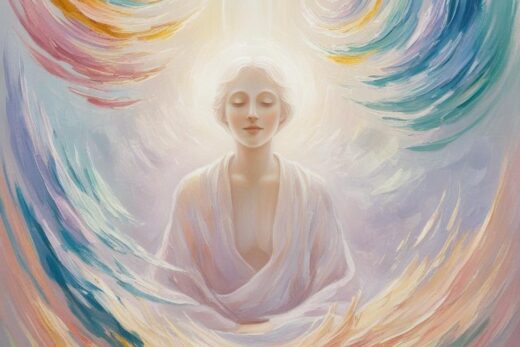
For Hildegard of Bingen, music was more than sound: it was a reflection of the harmony woven into creation. According to her, the human soul is symphonialis – „symphonic” – and human beings participate in a greater celestial harmony, where body, soul, creation, angels, and God are understood through relationships of harmony and proportion.
Her Symphonia armonie celestium revelationum (“Symphony of the Harmony of Celestial Revelations”) – a collection of 77 devotional chants – gives this vision musical form: earthly voices joining, however imperfectly, in the celestial Song. To be human, in Hildegard’s vision, is to be part of the celestial symphony. That feels quite empowering, doesn’t it?
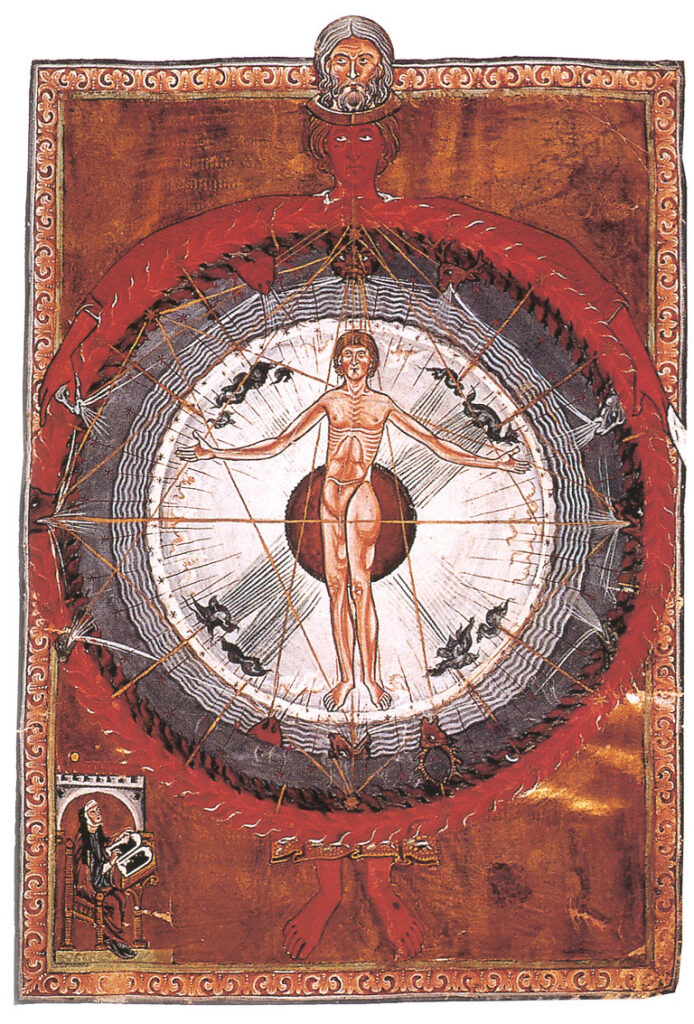
In this vision, the Universal / Cosmic Man, a human being, stands in the centre of creation, connected with the celestial forces by invisible strings (sound waves?). I leave it to your imagination and discernment what kind of divine forces you see around a human.
When I saw this depiction for the first time, several years ago, I’ve been intensely studying Human Design and the similarity of the information was striking, when I put a HD mandala next to it:

It was a moment when I understood that we are living in a vast field of information. We are always connected to it, we can tune ourselves to a given frequency and “download” whatever we need, or we are called to. Then we do our best to describe it, according to information that our brain can get at any given linear time-space continuum moment.
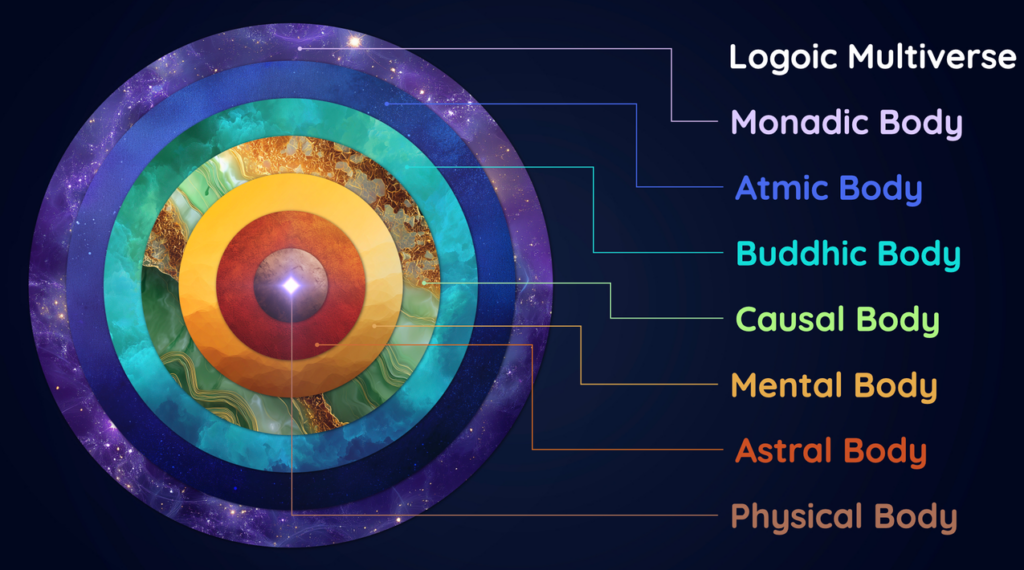
These days I’m contemplating the Gene Keys, and when I got back to Hildegard’s writings through a recent musical project I’ve attended, this is what I immediately saw in comparison to her Universal Man:
It’s just so interesting.
But let’s get back to Hildegard’s music. This is my interpretation of her hymn to the Divine Wisdom or Holy Spirit, O virtus Sapientiae. Although, Hildegard couldn’t say it straight in the 12th century, in her writings there is a deep feeling of feminine aspect of divinity, and this is how I interpret Divine Wisdom – a feminine aspect of god. Sophia.
Have a listen, and may the sound-light frequencies coming through my voice make your day better:
The second musical work of Hildegard, Ordo Virtutum, a semi-oratorio, goes even further in musically depicting the spiritual struggles of a soul incarnated in human flesh, torn between Virtues and Vices. Interestingly, the Devil is the only character in the piece who does not sing, but only shrieks and growls. Evil cannot be part of the celestial symphony, as it is incapable of producing harmonious sounds.
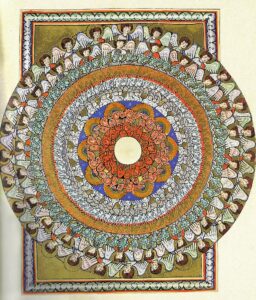
If any of this interests you, I highly recommend further reading:
– International Society of Hildegard von Bingen Studies: https://www.hildegard-society.org/p/home.html
– Atherton Mark (ed.), Hildegard of Bingen – Selected Writings, Penguin Books 2001.
Is there something that strikes you in her almost a thousand years old visions?